




Cooperative cuttlefish share their secrets of depth perception
Written by: Ben Burford, PhD Candidate, Stanford University
Edited by: Misty Paig-Tran, Assistant Professor, California State University Fullerton
Wardill & Gonzalez-Bellido wanted to
put 3-D glasses on cuttlefish
From
mantis shrimp striking snail shells to slingshot spiders shooting themselves at
flying insects, many of us at SICB report on the results of research that hinges
on the cooperation of our study subjects. This was especially true for Trevor Wardill, an Assistant
Professor at the University of Minnesota (UMN).
During a Whitman Center Fellowship undertaken at the Marine Resources Center at Marine Biological Laboratory (MBL) in the summer of 2018, Wardill and Paloma Gonzalez-Bellido (also an Assistant Professor at UMN) hoped to test a hypothesis. They wanted to know if cuttlefish use stereopsis to sense depth and 3-D structure, a process that relies on differences between the images produced by the left and right eye.

Trevor Wardill (left) and Paloma Gonzalez-Bellido (right), experts in neuroethology and cuttlefish couture.
However,
stereopsis has only been identified in one invertebrate species, the praying
mantis. Wardill suspected that cuttlefish might use stereopsis because, unlike
other cephalopod molluscs (squids, octopuses, and nautiluses), cuttlefish often
focus on the same object with both eyes. Thus, there can be substantial overlap
between what the left and right eyes see, a necessary element of stereopsis. Wardill
reasoned that the simplest way to test this hypothesis would be to get
cuttlefish to wear 3-D glasses.
3-D
glasses trick the brain of a visually-driven animal that uses stereopsis. A scenario
filmed, photographed, or animated from two side-by-side perspectives (like your
eyes), and then projected through two different polarizing filters can be
re-separated by your brain when viewed through the corresponding filters. This
is where 3-D glasses come in—they separate the left and right perspectives,
allowing your brain to focus on the disparities between them and create the
illusion of depth.
But
when was the last time you heard of cuttlefish wearing 3-D glasses? They don’t
for good reasons.
Cuttlefish aren’t
amenable to being accessorized
Imagine
a squishy pillow animal that can levitate. It has 8 noodly
arms and two tentacles where there should be a nose, fins that wrap around its
body like a ballerina’s tutu, and frog eyes that bulge out of the top if its
head. It glides around underwater like a UFO, changing directions as quick as
you can snap your fingers. Now imagine trying to put glasses on this pillow
animal. If the glasses don’t immediately fall off when it swims around, the
creature will most likely use its noodly appendages
to pull them off (perhaps pausing for a thoughtful chew before discarding
them).
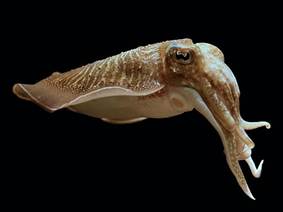
A common cuttlefish at Nausicaä Centre National de la Mer, Boulogne-sur-Mer, France. © Hans Hillewaert. Link to image on Wikipedia
But
wearing glasses would not be the only task that the cuttlefish would need to
master if the research was going to succeed. The animals would ultimately have
to strike at 3-D animations of their favorite food (shrimp) while simultaneously
wearing the glasses. This was all the more challenging because the cuttlefish
had to perform these strikes on cue in front of a camera. It’s difficult for
people to perform tasks on camera—let alone a little cuttlefish.
So
Wardill and his colleague hatched a plan: they
designed a series of tests to determine which of the 14 cuttlefish had the
right temperament and skillset to participate in the experiments—a special
taskforce of cuttlefish was to be formed.
Fourteen secondhand
specimens go to cuttlefish boot camp
All
the cuttlefish recruits had one thing in common—their age. “These animals were
quite old,” remembered Wardill, “nearly two years which is their maximum age.”
In addition, most specimens had already been the subjects of previous behavioral
research. “It was not surprising that some found the transition to our
experiments tough,” admitted Wardill.
So
were these geriatric cuttlefish up to the task? Can an old cuttlefish learn new
tricks? The first test in cuttlefish boot camp aimed to figure this out—this was
the inking test.
Just
like people, cuttlefish can have performance anxiety. But while people get a
dry mouth, shaky voice, or sweat, cuttlefish instead squirt ink. Like many
cephalopods, they produce ink using a gland inside the mantle cavity. Cuttlefish
that are scared or stressed will often spew clouds of the stuff in an attempt
to escape. Inking in the experimental tank would pose a problem for the researchers
if they were to capture the behavior of an individual on camera.
Surprisingly,
only one cuttlefish failed this first test by inking in the test tank, and thus
13 cuttlefish advanced to phase two of boot camp. One cuttlefish, later dubbed “Inky”
by the researchers, cooperated by holding its ink in during initial testing. However after passing the no ink test, Inky eventually
revealed a tendency to periodically ink in the test tank. But Inky’s performance in subsequent trials justified the
necessary cleanup.
The
second task that the cuttlefish had to master would involve a trip to the
shooting range. Here the marksmen were the cuttlefish and the targets were
videos of shrimp.
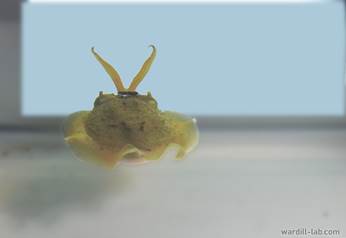
A cuttlefish facing the screen, ready to shoot its tentacles at an unsuspecting shrimp video. Note the small piece of Velcro® between the eyes. Image credit: P. Gonzalez-Bellido
All of the 13 non-inking cuttlefish would
readily hunt live shrimp in their tank. But for the experiment to work, the
cuttlefish needed to shoot their tentacles at videos of shrimp projected on a
screen in the tank. Eleven (including Inky) were willing to do so, and the
researchers reinforced this behavior with rewards of actual live shrimp. These
screen-shooting specimens passed trial two and advanced on to the next test.
The
third—and most anticipated—test was to get the non-inking, screen-shooting cuttlefish
to actually wear 3-D glasses. But how does one convince a cuttlefish to wear
3-D glasses? In a stroke of genius, the researchers decided that Velcro® would
be useful for this task. The researchers glued a small piece of Velcro® to the
top of each cuttlefish’s head between the eyes. They then glued a second piece
of Velcro to the 3D glasses. The glasses could then be quickly attached and
removed without causing damage to the animals.
The
researchers went through several iterations of cuttlefish couture. Early
versions of the glasses were wrap-around (think 80’s style athletic sunglasses),
but these were quickly scrapped for logistical reasons. Remarkably, it wasn’t
the cuttlefish removing the glasses with their arms that was the primary problem—it
was their locomotion.
Cuttlefish
use a mixture of fin undulation and jet propulsion that enables them to quickly
move forward (arms-first) or backward (mantle-first). Wrap-around glasses created
too much drag and fell off when the animals’ jetted backwards during strikes or
when spooked. A simple switch to aviator-style 3-D glasses (see above image) allowed
the nine most agreeable cuttlefish to keep their glasses on while they swam. “We
later realized that it was only the forward facing part of the vision that was
needed so this final style worked well,” said Wardill.
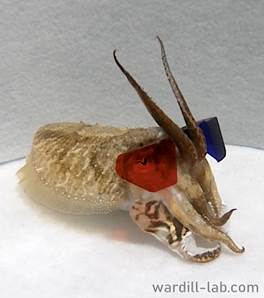
“Long arms” was not interested in the screen, but happy to wear his 3-D glasses. Image credit: R. Feord
Cooperative cuttlefish share
their secrets of depth perception
Have
you ever taken off your 3-D glasses during a 3-D horror film and looked around
at the audience? It’s hilarious. Without glasses on, the movie screen shows a
blurry monster revealing itself from behind a door (whoop-de-doo). But the
audience gasps and jolts backward in their seats. To them, this monster
appeared crisp, clear, and right in front of them—so close they should have
smelled its breath.
Common
cuttlefish are exceptionally accurate when it comes to striking at prey
(previous work documented 85-90% accuracy in lab). Where an animal shoots its
tentacles reveals where it perceives the prey to be. Wardill knew that if
cuttlefish didn’t use stereopsis to generate depth perception, then animals
wearing 3-D glasses would always shoot their tentacles at the screen (where the
animated shrimp was projected) regardless of how the researchers manipulated
the 3-D footage. The shrimp would appear to the cuttlefish as the monster did
to you without glasses on—on the screen.
On
the other hand, if cuttlefish did use stereopsis, then the researchers could
control where the cuttlefish perceived the shrimp to be. Like the monster, the
shrimp could be animated to pop out from the screen and appear closer to the
cuttlefish than it actually was. It could also be animated to appear off in the
distance behind the screen. By manipulating the projected 3-D images of shrimp
and watching where the animals struck, the research could determine if
cuttlefish indeed use stereopsis.
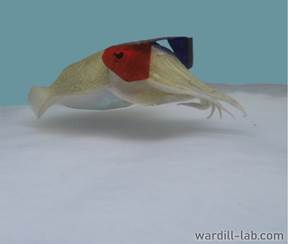
A member of the cooperative cuttlefish task force preparing for action. Image credit: P. Gonzalez-Bellido
Wardill and his colleagues
showed that cuttlefish have stereopsis, and therefore perceive depth and 3-D
structure in their world in much the same way as we do—a remarkable example of evolutionary
convergence. But the researchers learned even more from these cooperative
cuttlefish, information that highlights some unique features of their
stereopsis.
The
researchers noticed a peculiar occurrence during some of the strikes at
animated shrimp—the eyes of their study subjects were not evenly converged on
the target. In some cases, there was a disparity in the orientation of the
right and left eye of up to 10 degrees (relative to the body axis).
Like
chameleons, cuttlefish can move their eyes together or independently—perhaps resulting
in cuttlefish being somewhat cross-eyed when striking at prey. Because
cuttlefish eyes have low spatial resolution compared to some vertebrates, Wardill
suspects that this is unlikely to impact the precision of their tentacle
strikes. In fact, the researchers believe this piece of evidence may narrow the
search for a potential neural mechanism that cuttlefish use to calculate
differences between what the left and right eyes see, thereby generating depth
perception.
The
discoveries made by Wardill and his team involved a great deal of creativeness
on their part, and also a willingness to try something that was likely to fail.
As many of us at SICB know, specimens almost never cooperate when you want them
to. Just as important to the success of this research was the remarkable
cooperation of a handful of cuttlefish. As it says on the Wardill Lab website, “it’s better to be lucky than good.”
Let’s
take a moment to thank the cooperative cuttlefish task force that so graciously
let us watch them engage in the most epic round of virtual shrimp round-up.
This research appears in Vol. 6, Iss. 2 of the journal Science
Advances.
Hyperlinks:
The Wardill Lab
Fly Systems Lab
Wikipedia image of
common cuttlefish
https://commons.wikimedia.org/wiki/File:Sepia_officinalis_(aquarium).jpg
.jpg)
Trevor Wardill’s YouTube page
https://www.youtube.com/channel/UC2bRD_CU0tfuyb68dUkbi8A/featured
Research article
https://advances.sciencemag.org/content/6/2/eaay6036
